No sports car is as recognisable as the Porsche 911. Since the 1960s it has kept the same basic recipe: a flat-six boxer engine in the rear and that famous sloping roofline. Yet every generation is different. In this article you will learn which 911 generations exist, what makes each one special and how to tell them apart.
Every Porsche 911 generation at a glance
| Generation | Years | Cooling | How to recognise it |
|---|---|---|---|
| Original (901/911) | 1964 – 1973 | Air | Slim chrome bumpers, delicate lines |
| G-series | 1974 – 1989 | Air | Large impact bumpers with rubber bellows |
| 964 | 1989 – 1994 | Air | Smooth, integrated plastic bumpers |
| 993 | 1994 – 1998 | Air | Flatter, sloping headlights, wider hips |
| 996 | 1997 – 2005 | Water | 'Fried egg' headlights with integrated indicators |
| 997 | 2004 – 2012 | Water | Round, oval headlights return |
| 991 | 2011 – 2019 | Water | Longer wheelbase, slim tail lights |
| 992 | since 2019 | Water | Full-width light bar across the rear |
Production years sometimes overlap, because a new coupé arrived while the cabriolet or Turbo of the previous generation continued for a while.
The original 911 (1964 – 1973)
Porsche unveiled the successor to the 356 at the 1963 Frankfurt Motor Show as the 901. Peugeot, however, held the rights to three-digit model numbers with a zero in the middle, so the car became the 911. The first version had a 2.0-litre six-cylinder engine with 130 hp. The Targa with its roll bar followed, as did the lightweight Carrera RS 2.7 with its famous 'ducktail' spoiler, now one of the most sought-after 911s of all.
The G-series (1974 – 1989)
New American safety rules gave the 911 larger impact bumpers with rubber bellows in 1974. The G-series stayed in production for fifteen years and included legendary versions such as the 930 Turbo (from 1975), the 911 SC and the Carrera 3.2. A cabriolet arrived in 1983.
The 964 (1989 – 1994)
The 964 looked familiar but was largely new. It gained power steering, ABS, an automatically extending rear spoiler and, as the first 911, all-wheel drive: the Carrera 4. The Tiptronic automatic gearbox also made its debut.
The 993 (1994 – 1998): the last air-cooled 911
For many enthusiasts the 993 is the most beautiful 911. It is the last air-cooled 911, with flowing lines, more steeply raked headlights and a new multi-link rear suspension. The 993 Turbo received twin turbochargers and all-wheel drive. Good examples are highly sought after today.
The 996 (1997 – 2005): the first water-cooled 911
The 996 was a major break with the past: a water-cooled engine and a completely new body. Its headlights, shared with the Boxster, earned the nickname 'fried eggs'. For years the 996 was the least loved 911, which is exactly why it is now an affordable way in. The first GT3 is also a 996.
The 997 (2004 – 2012)
With the 997 the classic round headlights returned. From the 2008 facelift (the 997.2) it gained direct fuel injection and the quick-shifting dual-clutch PDK gearbox. Many experts see the 997 as the ideal balance between classic feel and modern technology.
The 991 (2011 – 2019)
The 991 grew larger and more comfortable, with a longer wheelbase and electric power steering. With the 2015 facelift (the 991.2) the regular Carrera models were turbocharged for the first time. In 2017 the one-millionth 911 rolled off the line.
The 992 (since 2019)
Today's 992 is wider, more digital and recognisable by the light bar across the entire rear. With the 2024 facelift came the GTS with hybrid drive, a first for the 911.
How to identify a 911 generation at a glance
- Look at the bumpers. Thin chrome bumpers: original model. Bumpers with rubber bellows: G-series. Smooth, integrated bumpers without bellows: a 964 or later.
- Look at the headlights. Upright and round: up to the 964. Sloping and flat: 993. Teardrop-shaped 'fried egg': 996. Oval again: 997 and later.
- Look at the rear. A full-width light bar means a 992.
- Listen to the engine. An air-cooled 911 (up to 1998) has a drier, rawer sound and a large cooling fan in the engine bay.
Your 911 as a work of art
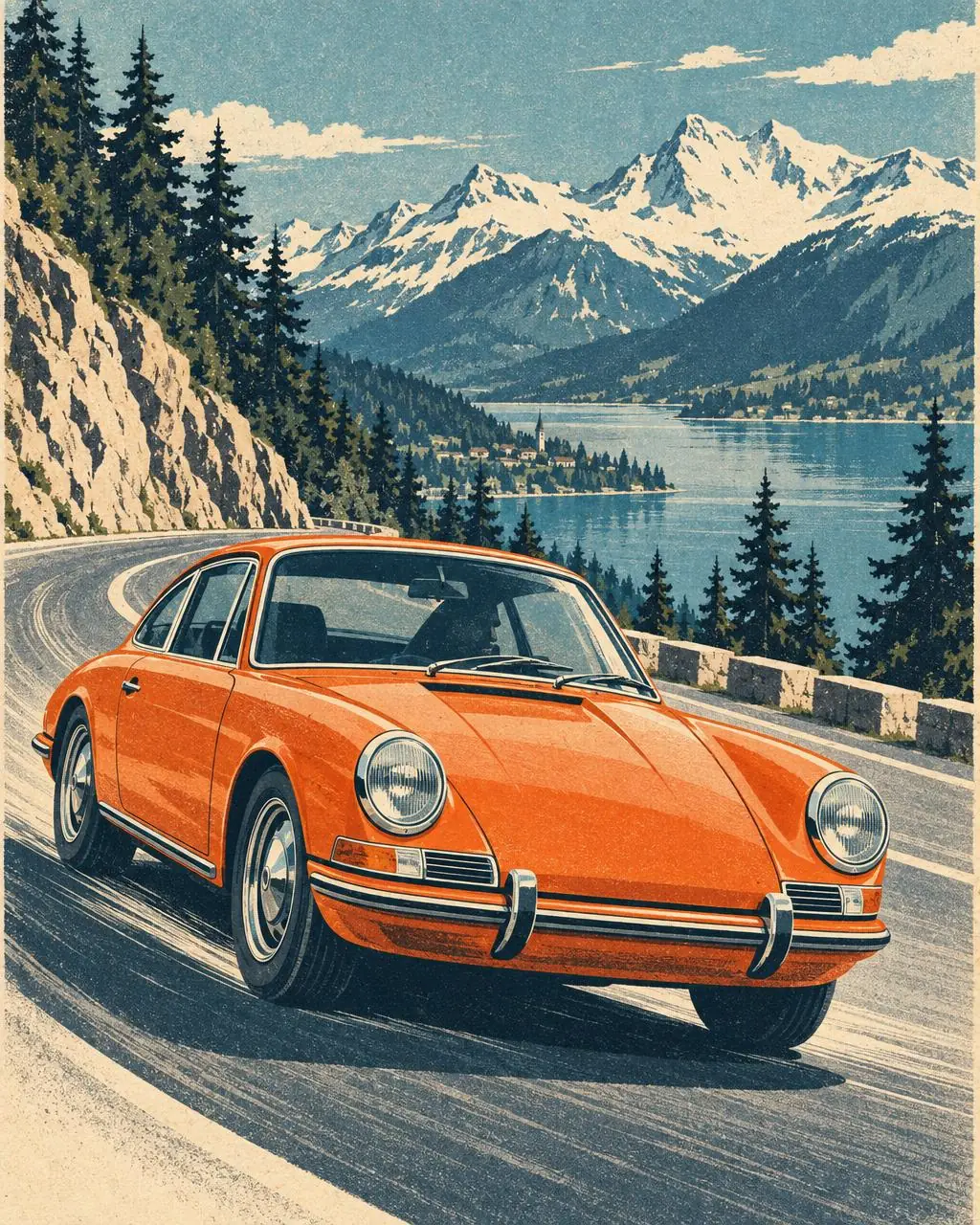
Whether you have a G-series in the garage or dream of a 993, a 911 deserves a place on the wall. With our car portrait you turn a photo of your car into a work of art: as a retro racing poster like the one above, a cinematic photo, a technical illustration or ink and watercolour. You see a free preview first and then choose a poster or digital download from our products.
Get Your Print Together is not affiliated with Porsche AG. Porsche and 911 are trademarks of their respective owners.