From the jet-black Friesian to the fluffy Shetland and the elegant Arabian: there are more than 300 horse breeds in the world. Each was bred for its own purpose, such as speed, strength, stamina or a calm temperament. In this article you will learn how horses are grouped, which breeds are the best known and which breed might suit you.
The four groups: hot-blood, warmblood, cold-blood and pony
Horse breeds are usually grouped by build and temperament, not by body temperature. All horses have the same temperature.
- Hot-bloods are lightly built, fast and sensitive. Think of the Thoroughbred and the Arabian.
- Warmbloods were created by crossing hot-bloods with heavier horses. They are athletic riding horses for show jumping, dressage and eventing, such as the Dutch Warmblood (KWPN) and the Hanoverian.
- Cold-bloods are heavy, calm draft horses with great strength, such as the Shire, the Clydesdale and the Belgian draft.
- Ponies are horses that measure up to 14.2 hands (148 cm) at the withers. They are often strong, clever and good doers.
The Friesian sits somewhere in between: heavier than a warmblood, but lighter and more elegant than a true draft horse.
The best-known horse breeds at a glance
Height is measured from the ground to the withers, the highest point of the back just behind the mane. One hand is 4 inches (10.16 cm). The figures below are typical ranges; an individual horse can fall outside them.
| Breed | Origin | Height | Known for |
|---|---|---|---|
| Friesian | Netherlands | approx. 15.1 – 17.1 hh (155 – 175 cm) | Black coat, long mane, high knee action |
| Dutch Warmblood (KWPN) | Netherlands | approx. 16.1 – 17.1 hh (165 – 175 cm) | Top-level jumping and dressage |
| Hanoverian | Germany | approx. 15.3 – 17.1 hh (160 – 175 cm) | Versatile sport horse |
| Thoroughbred | England | approx. 15.2 – 17 hh (157 – 173 cm) | Racing speed |
| Arabian | Arabian Peninsula | approx. 14.1 – 15.1 hh (145 – 155 cm) | Stamina, refined head, high tail carriage |
| Andalusian (PRE) | Spain | approx. 15.1 – 16.1 hh (155 – 165 cm) | Baroque build, often grey |
| Lipizzaner | Austria and Slovenia | approx. 14.3 – 15.3 hh (150 – 160 cm) | Spanish Riding School in Vienna |
| American Quarter Horse | United States | approx. 14.1 – 15.3 hh (145 – 160 cm) | Sprinting and western riding |
| Appaloosa | United States | approx. 14.1 – 15.3 hh (145 – 160 cm) | Spotted coat |
| Haflinger | Austria and South Tyrol | approx. 13.2 – 14.3 hh (138 – 150 cm) | Chestnut with a flaxen mane |
| Fjord | Norway | approx. 13.1 – 14.3 hh (135 – 150 cm) | Dun colour, upright mane |
| Gypsy Cob (Irish Cob) | Ireland and Britain | approx. 13.1 – 15.3 hh (135 – 160 cm) | Coloured coat and heavy feathering |
| Welsh pony and cob | Wales | approx. 11.3 – 15.1 hh (120 – 155 cm), by section | Friendly children's and riding pony |
| Shetland pony | Shetland Islands | up to 42 inches (107 cm) | Small, strong and cheeky |
| Belgian draft | Belgium | approx. 15.3 – 17.1 hh (160 – 175 cm) | Huge strength, often over 900 kg |
| Shire | England | approx. 16.3 – 18.3 hh (170 – 190 cm) | One of the tallest breeds |
Popular breeds in Britain and Ireland
The Thoroughbred was developed in England for racing. Every Thoroughbred traces back to three stallions imported around 1700: the Byerley Turk, the Darley Arabian and the Godolphin Arabian.
The Clydesdale from Scotland and the Shire from England are the gentle giants of British farming, recognisable by their white feathering. The Irish Draught and the Connemara pony from Ireland are known as sound, sensible riding horses and are often crossed with Thoroughbreds to produce top event horses.
Among ponies, the Welsh pony and cob (sections A to D) and the Shetland are classic first ponies for children, while the New Forest pony and the Exmoor are native breeds that still live semi-wild in their home regions.
Sport horses: fast and athletic
For competition, riders usually choose a warmblood such as the Dutch Warmblood, the Hanoverian, the Holsteiner or the Oldenburg. They combine power with suppleness and a willing temperament.
The Arabian is one of the oldest breeds in the world and has influenced many others. Arabians excel at endurance riding: long-distance rides of 80 kilometres (50 miles) or more. In the United States, the American Quarter Horse, named after its speed over a quarter mile, is the go-to breed for western disciplines.
Ponies: small but versatile
A pony is not a young horse; it is an adult animal that stays small. Ponies are often good doers, which means they gain weight easily. Keep an eye on their grazing, because too much rich grass can lead to laminitis. The Haflinger and the Fjord sit on the border between pony and horse in size and can carry adults comfortably.
Draft horses: the gentle giants
Cold-bloods were once used on farms, in forestry and for heavy wagons. The Belgian draft can weigh more than 900 kilograms. The Shire is among the tallest breeds: the tallest horse ever recorded, a Shire called Sampson, stood 21.2½ hands (2.19 metres) in the 19th century. Despite their size, draft horses are usually calm and kind.
Which horse breed suits you?
Ask yourself these questions before choosing a breed:
- What do you want to do? For competition, a warmblood suits best; for hacking, a calm and sure-footed breed such as the Haflinger or the Fjord.
- How experienced are you? Thoroughbreds and Arabians are sensitive and quick to react. Beginners often feel safer on a level-headed breed.
- How tall and heavy are you? A Shetland suits small children, while a cob or a Friesian carries an adult rider easily.
- How much time and money do you have? A sport horse needs a lot of training; a hardy native pony can often live out more.
Remember: the individual horse, its upbringing and its training matter at least as much as the breed.
Coat colour and breed are not the same
A colour is not a breed. A grey, chestnut, bay or coloured (piebald or skewbald) horse can belong to many different breeds. Only some breeds have a fixed colour, such as black for the Friesian and dun for the Fjord. Want to know a horse's breed? Check its passport, which lists the stud book and pedigree.
Your horse as a work of art
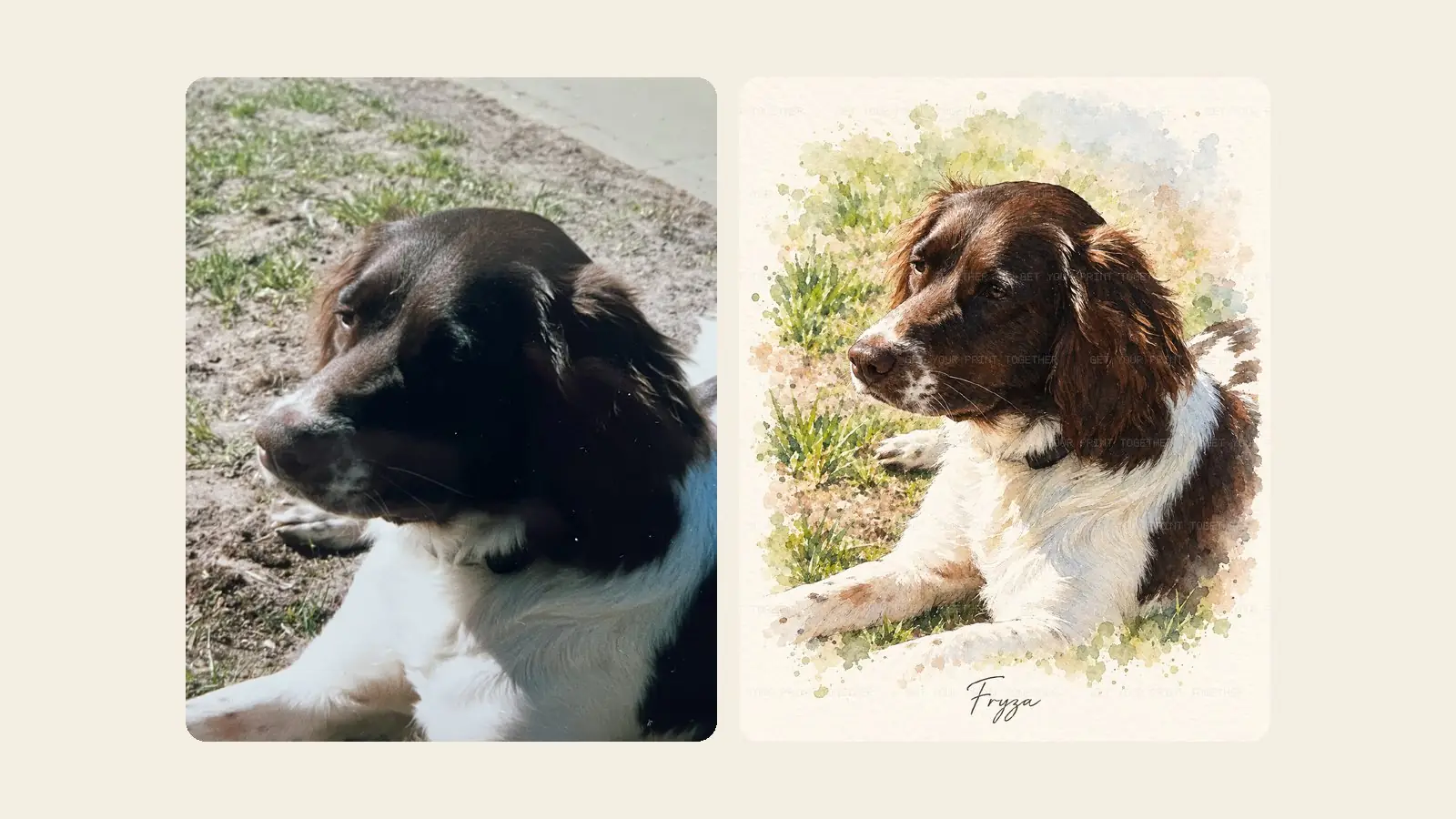
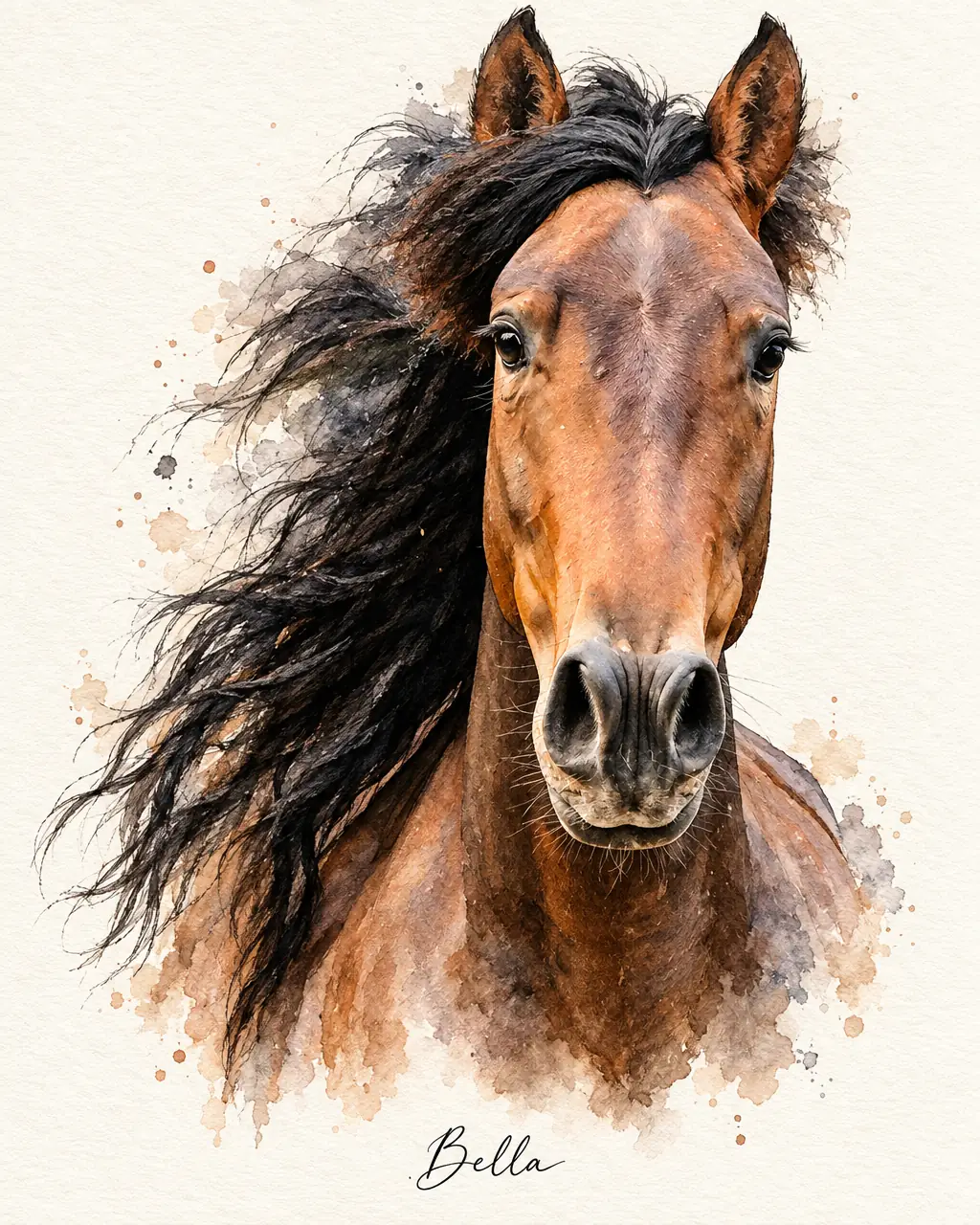
Whatever breed your horse is, it deserves a place of honour. With our horse portrait you turn an ordinary photo into a work of art: a fine pencil portrait, charcoal and chalk on toned paper, a painted portrait on black, a colourful palette-knife painting or ink and watercolour, each with your horse's name beneath it. You see a free preview first and then choose a poster or digital download from our products.